
CRC is a powerful amplifier power supply. Measurements, characteristics

| Testing device | CRC powerful power supply, measurements |
| Sampling mode | 24-bit, 48 kHz |
| Interface | E-MU1616m |
| Testing chain | E-MU1616m>Amplifier AUDIOPHILE, 100W>E-MU1616m |
| Constant voltage DC | -43В...0...+43В |
| Load resistance | 4 Ohm |
| Testing power | 80W |
| Quiescent current | 120mA |
| 20 Hz - 20 kHz filter | ON |
| Normalize amplitude | ON |
| Level change | -0.3 dB / -0.3 dB |
| Mono mode | ON |
| Calibration singal, Hz | 1000 |
| Polarity | correct/correct |
Summary, C-filter
| Ripple level, peak voltage, mV | 31 |
Good |
| Frequency response (from 40 Hz to 15 kHz), dB | +0.02, -0.11 |
Excellent |
| Noise level, dB (A) | -100.1 |
Excellent |
| Dynamic range, dB (A) | 100.0 |
Excellent |
| THD, % | 0.00912 |
Very good |
| THD + Noise, dB (A) | -77.4 |
Average |
| IMD + Noise, % | 0.081 |
Good |
| IMD at 10 kHz, % | 0.047 |
Good |
| General performance | Very good |
Summary, CRC-filter
| Ripple level, peak voltage, mV | 9 |
Very good |
| Frequency response (from 40 Hz to 15 kHz), dB | +0.02, -0.11 |
Excellent |
| Noise level, dB (A) | -106.1 |
Excellent |
| Dynamic range, dB (A) | 105.6 |
Excellent |
| THD, % | 0.00797 |
Very good |
| THD + Noise, dB (A) | -78.7 |
Average |
| IMD + Noise, % | 0.012 |
Very good |
| IMD at 10 kHz, % | 0.047 |
Good |
| General performance | Very good |
PSU output ripple C-filter

Meaning |
|
| Ripple level, peak voltage, mV | 31 |
Ripple at the output of the power supply CRC-filter

Meaning |
|
| Ripple level, peak voltage, mV | 9 |
Frequency response

Left |
Right |
|
| From 20 Hz to 20 kHz, dB (C-filter) | -0.19, +0.02 |
-0.19, +0.02 |
| From 20 Hz to 20 kHz, dB (CRC-filter) | -0.19, +0.02 |
-0.19, +0.02 |
| From 40 Hz to 15 kHz, dB (C-filter) | -0.11, +0.02 |
-0.11, +0.02 |
| From 40 Hz to 15 kHz, dB (CRC-filter) | -0.11, +0.02 |
-0.11, +0.02 |
Noise level
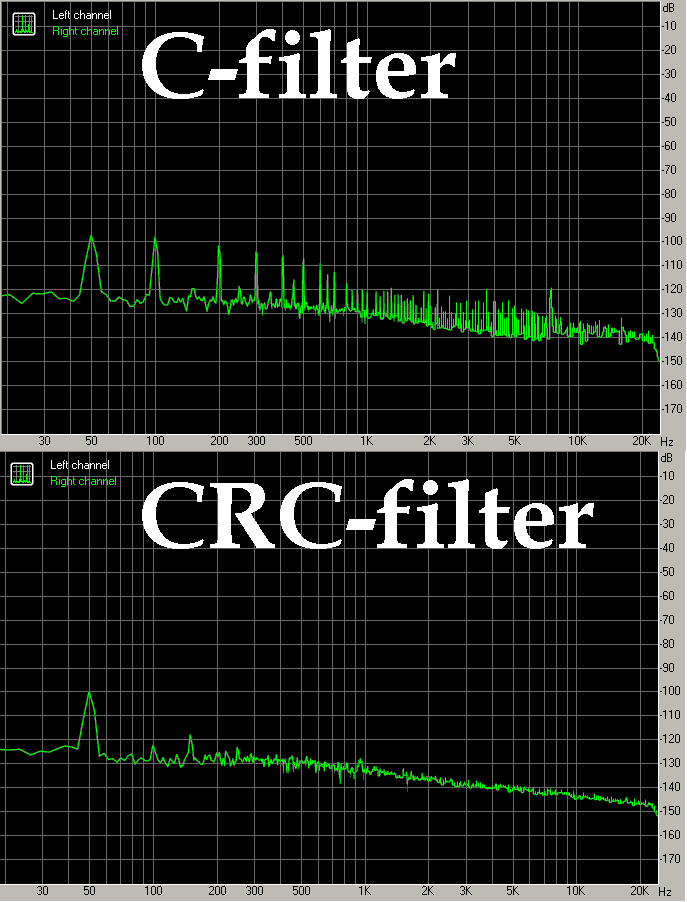
Left |
Right |
|
| RMS power, dB (C-filter) | -94.3 |
-94.3 |
| RMS power, dB (CRC-filter) | -100.6 |
-100.6 |
| RMS power (A-weighted), dB (C-filter) | -100.1 |
-100.1 |
| RMS power (A-weighted), dB (CRC-filter) | -106.1 |
-106.1 |
| Peak level, dB (C-filter) | -72.7 |
-72.7 |
| Peak level, dB (CRC-filter) | -73.1 |
-73.1 |
| DC offset, % (C-filter) | -0.0 |
-0.0 |
| DC offset, % (CRC-filter) | -0.0 |
-0.0 |
Dynamic range

Left |
Right |
|
| Dynamic range, dB (C-filter) | +94.7 |
+94.7 |
| Dynamic range, dB (CRC-filter) | +100.5 |
+100.5 |
| Dynamic range (A-weighted), dB (C-filter) | +100.0 |
+100.0 |
| Dynamic range (A-weighted), dB (CRC-filter) | +105.6 |
+105.6 |
| DC offset, % (C-filter) | +0.00 |
-0.00 |
| DC offset, % (CRC-filter) | +0.00 |
-0.00 |
THD + Noise (at -3 dB FS)

Left |
Right |
|
| THD, % (C-filter) | 0.00912 |
0.00912 |
| THD, % (CRC-filter) | 0.00797 |
0.00797 |
| THD + Noise, % (C-filter) | 0.02211 |
0.02211 |
| THD + Noise, % (CRC-filter) | 0.00957 |
0.00957 |
| THD + Noise (A-weighted), % (C-filter) | 0.01351 |
0.01351 |
| THD + Noise (A-weighted), % (CRC-filter) | 0.01166 |
0.01166 |
Intermodulation distortion

>
Left |
Right |
|
| IMD + Noise, % (C-filter) | 0.08068 |
0.08068 |
| IMD + Noise, % (CRC-filter) | 0.01196 |
0.01196 |
| IMD + Noise (A-weighted), % (C-filter) | 0.01497 |
0.01497 |
| IMD + Noise (A-weighted), % (CRC-filter) | 0.00823 |
0.00823 |
IMD (swept tones)

Left |
Right |
|
| IMD + Noise at 5000 Hz, (C-filter) | 0.02930 |
0.02930 |
| IMD + Noise at 5000 Hz, (CRC-filter) | 0.02959 |
0.02959 |
| IMD + Noise at 10000 Hz, (C-filter) | 0.04487 |
0.04487 |
| IMD + Noise at 10000 Hz, (CRC-filter) | 0.04436 |
0.04436 |
| IMD + Noise at 15000 Hz, (C-filter) | 0.06681 |
0.06681 |
| IMD + Noise at 15000 Hz, (CRC-filter) | 0.06624 |
0.06624 |
Conclusions
| First of all, it should be noted that the number of characteristics of a transformer power supply is very small and,
perhaps, the only characteristic that can be measured and visually demonstrated is the level of ripple of the DC
output voltage of this module. However, in addition to the reduced level of ripple, thanks to the CRC filter, the
principle of operation of the power supply has been slightly changed, due to which the time and “smoothness” of the
discharge of the PSU capacitors slightly increase. This process is very difficult to measure and visualize, after all,
the power supply was created exclusively for audio frequency power amplifiers with one and two polar power supplies,
and it is the measurements of the amplifier powered by this power supply that will be indirect characteristics that
directly indicate the effectiveness of this solution.
At the same time, it is necessary to clarify that the influence of the quality of power supplies is far from being
as obvious in all cases as in this one, and the trend is approximately the following: the lower the level and
quality of the amplifier, the less obvious the influence of the power supply on it. For measurements,
an AUDIOPHILE, 100W amplifier operating in class AB was chosen, since the level and quality of this amplifier is
at a fairly high level, which is confirmed by our laboratory measurements.
The design of this module makes it easy to convert it from the CRC-filter version to the C-filter version,
for this powerful resistors are removed and specially provided power tracks are poured with solder. It was this
procedure that was carried out during the transition and measurements with different types of filters; otherwise,
the measuring stand did not undergo any changes.
Summary: As we can see, there is a difference in numbers and in some characteristics it is quite significant, but not every listener will be able to hear it, because it is at a very low level of audibility. But if we analyze these very low levels according to the spectra of the graphs, then the difference here is very large in favor of the CRC filter. The spectra of the amplifier with a CRC filter come close to a stabilized power supply, which results in a softer and cleaner sound. Also, the possibility of excitation of the amplifier with this power supply is significantly reduced. Another indisputable advantage of this implementation of the power supply is an increase in the safety of the device as a whole, since the resistors of the CRC filter, indirectly, act as fuses, and if a powerful fuse (10A+) is installed in the primary circuit of the transformer, they will burn out and break the short circuit. The downside of the CRC filter is a slight decrease in efficiency of 2-5% compared to a power supply based on a C-filter, hence the same decrease in the maximum power of the amplifier, however, this indicator correlates with 220V mains voltage drops and is not significant. The second disadvantage of this particular module is its weight and size, and this must be taken into account when designing and assembling a finished amplifier in a case. The module can be recommended as a basis for building a high-quality, stationary power amplifier in a spacious case. You can buy this power supply from our kit-amp.com store. The module is literally the "Golden Mean" between conventional C-filter based power supplies and stabilized, linear, transistorized power supplies. |
Related Products

Amplifier power supply up to +/- 63V
Universal board of a bipolar power supply for the power amplifier.Ideal for chips like TDA2030A / TDA2050 / TDA7293 / TDA7294 / LM1875 / LM3875 / LM3886 and transistor amplifiers up to 250WThis power ..
1,830.00грн.

CRC powerful amplifier power supply, +/-100V
The sound quality of the amplifier directly depends on the quality of the power supply. Of course, there are limits imposed by the rest of the parts, but in general, quite high requirements are placed..
4,270.00грн.

Bipolar, powerful amplifier power supply, +/-100V
Universal bipolar power supply module for a powerful AF amplifier.Perfect for transistor amplifiers up to medium and high power. The power supply is designed for connection to two secondary windings o..
2,750.00грн.
Related Articles

Measurement technique
Any more or less complex electronic device requires a functional check and adjustmentThe audio power amplifier is no exception and measurements of the characteristics of this device are not only a dev..
Products viewed

Amplifier with adjustable D-class, PAM8610, 2x10W
Miniature amplifier with volume control, class D on a PAM8610 chip from the American company Power A..
80.00грн.