
JLH 1969, amplifier testing. Characteristics Measurement

| Testing device | JLH 1969 amplifier |
| Sampling mode | 24-bit, 48 kHz |
| Interface | E-MU1616m |
| Testing chain | E-MU1616m>JLH 1969 amplifier>E-MU1616m |
| Constant voltage DC | 25V |
| Load resistance | 4 Ohm |
| Testing power | 3W |
| Maximum power | 10W |
| Output transistors | 2SC5200 TOSHIBA |
| Quiescent current | 3A |
| 20 Hz - 20 kHz filter | ON |
| Normalize amplitude | ON |
| Level change | -0.3 dB / -0.3 dB |
| Mono mode | ON |
| Calibration singal, Hz | 1000 |
| Polarity | correct/correct |
Summary
| Frequency response (from 40 Hz to 15 kHz), dB | +0.02, -0.32 |
Very good |
| Noise level, dB (A) | -109.4 |
Excellent |
| Dynamic range, dB (A) | -109.4 |
Excellent |
| THD, % | 0.044 |
Good |
| THD + Noise, dB (A) | -64.8 |
Average |
| IMD + Noise, % | 0.042 |
Good |
| IMD at 10 kHz, % | 0.039 |
Good |
| General performance | Very good |
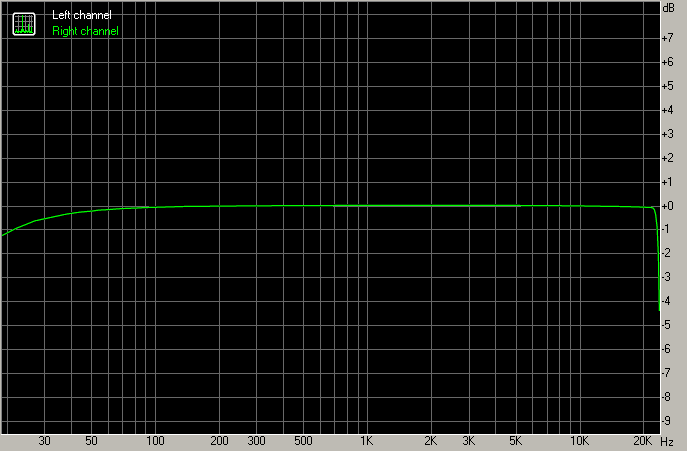
Frequency response
Left |
Right |
|
| From 20 Hz to 20 kHz, dB | -1.13, +0.02 |
-1.13, +0.02 |
| From 40 Hz to 15 kHz, dB | -0.32, +0.02 |
-0.32, +0.02 |
Noise level

Left |
Right |
|
| RMS power, dB | -106.6 |
-106.6 |
| RMS power (A-weighted), dB | -109.4 |
-109.4 |
| Peak level, dB FS | -90.1 |
-90.1 |
| DC offset, % | -0.0 |
-0.0 |
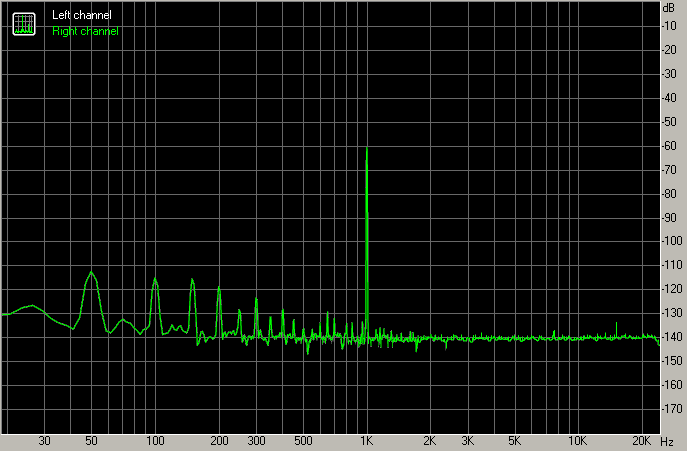
Dynamic range
Left |
Right |
|
| Dynamic range, dB | +106.4 |
+106.4 |
| Dynamic range (A-weighted), dB | +109.1 |
+109.1 |
| DC offset, % | +0.00 |
-0.00 |
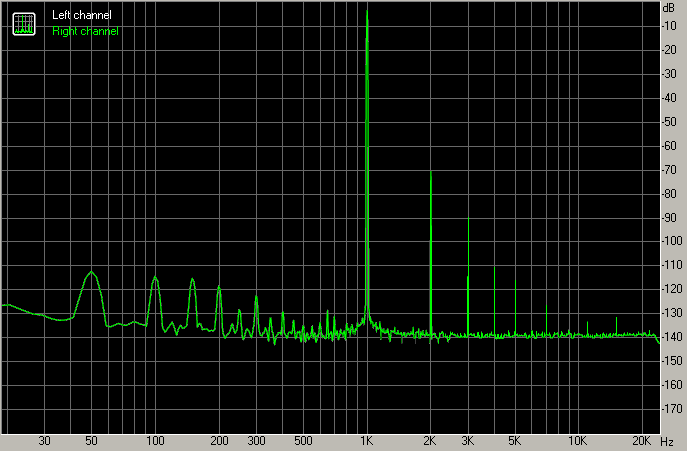
THD + Noise (at -3 dB FS)
Left |
Right |
|
| THD, % | 0.04410 |
0.04410 |
| THD + Noise, % | 0.04410 |
0.04410 |
| THD + Noise (A-weighted), % | 0.05749 |
0.05749 |
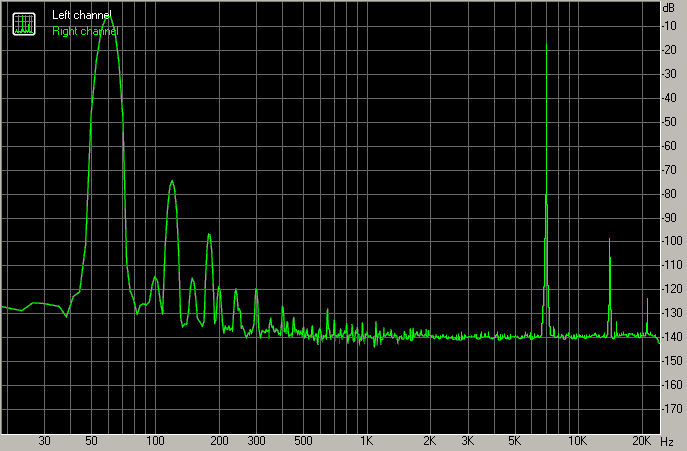
Intermodulation distortion
Left |
Right |
|
| IMD + Noise, % | 0.04191 |
0.04191 |
| IMD + Noise (A-weighted), % | 0.02496 |
0.02496 |
IMD (swept tones)
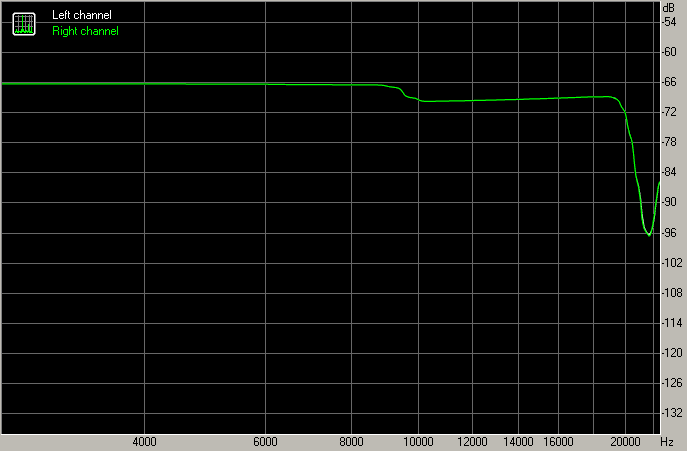
Left |
Right |
|
| IMD + Noise at 5000 Hz, | 0.04857 |
0.04857 |
| IMD + Noise at 10000 Hz, | 0.03401 |
0.03401 |
| IMD + Noise at 15000 Hz, | 0.03461 |
0.03461 |
Conclusions
| The classic case when measurements about sound can say practically nothing. Yet in the received characteristics have something to discuss: The original design was taken as a basis for the design of this amplifier. JLH 1969 circuit and transferred to a modern element base. Additionally, changes have been made to the scheme and improvements to reduce noise and background, resulting in a record low noise level of -109.4dB. This revision allows you to abandon the stabilized power supply and for normal operation amplifier, a conventional power supply is enough - diode bridge + smoothing capacitors 20,000 uF, in compliance with the only rule for all amplifiers with a transformer power supply - the maximum possible distance from transformer to amplifier. |
| Correctly routed and designed PCB, super compact and in the shortest possible length tracks allows the use of such fast transistors as 2SC5200 absolutely stable and without any excitement. |
| Using only high quality components, including original transistors of all stages and 1 W resistors ensure the reliability and durability of the module, provided that it is properly used and well cooled. |
| Due to the low power of this amplifier - 10 W, a small "blockage" of the frequency response from 50 Hz and below was created, so that delay the LF overload. You need to understand that 10 watts, even if honest, is not "bass" power. |
| As for harmonic distortion, the prevailing second harmonic at the level of -65dB is rather a proprietary the handwriting of the amplifier, for which several generations of high-quality sound lovers love it so much. |
|
Summary: all the positive reviews about this JLH 1969 amplifier are true. Lightweight and crystal clear (with the correct source) the sound immediately stands out from the background of other amplifiers, even without comparison "head-on". At the same time, you need to remember that this is a pure A class and with an output power of 2x10W, the amplifier will consume 100-150W from the mains (depending on the quiescent current) and the main thing is that the radiator is not decently large size for passive cooling - about 3000 sq. cm. per channel. This amplifier can be recommended for high quality bookshelf acoustics with woofer up to 16cm and broadband speaker systems. You can buy the amplifier in our store kit-amp.com. Also JLH 1969 can be recommended as a driver of tweeter / midrange speakers in Bi-amping and Tri-amping systems in air-conditioned rooms and if electricity bills are not that important. Unleash the potential of an amplifier possible only when using a signal source and acoustics of a sufficiently high level |
Related Products

JLH1969, amplifier A class (2N3055)
Assembled and tested amplifier module in class A - JLH1969 on a modern element base. Despite the simple design and minimum components, this amplifier is still in the “top” of solutions for high-qualit..
1720.00грн.

Amplifier JLH 2005, 30W
Over the past 50 years, progress in the electronics industry has come a long way. But the same cannot be said about the technique for reproducing sound. For almost a hundred years since the invention ..
2190.00грн.

Amplifier JLH 1969, 10W
Over the past 50 years, progress in the electronics industry has come a long way. But the same cannot be said about the technique for reproducing sound. For almost a hundred years since the invention ..
1950.00грн.
Related Articles

Measurement technique
Any more or less complex electronic device requires a functional check and adjustmentThe audio power amplifier is no exception and measurements of the characteristics of this device are not only a dev..

Amplifier HITACHI 100W, measurements
Testing device Amplifier HITACHI 100W Sampling mode 24-bit, 48 kHz Interface E-MU1616m Testing chain E-MU1616m>Amplifier HITACHI 100W>E-MU1616m Consta..

JLH 2005, amplifier class A, measurements
Testing device JLH 2005 amplifier class A Sampling mode 24-bit, 48 kHz Interface E-MU1616m Testing chain E-MU1616m>JLH 2005 amplifier class A>E-MU1616m ..