
Testing the MOSFET 100W amplifier. Measurements, specifications
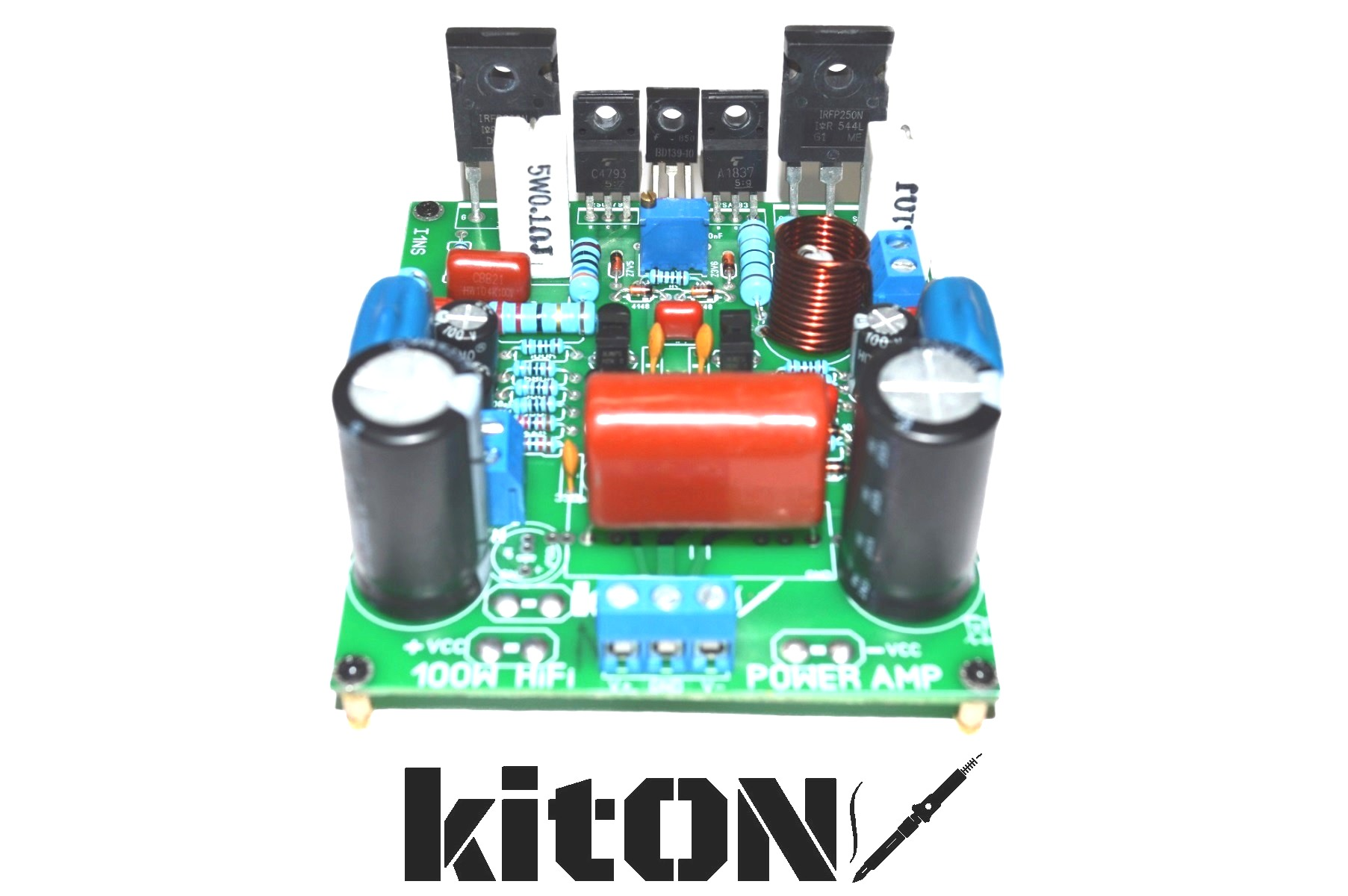
| Testing device | Amplifier MOSFET 100W |
| Sampling mode | 24-bit, 48 kHz |
| Interface | E-MU1616m |
| Testing chain | E-MU1616m>Amplifier MOSFET 100W>E-MU1616m |
| Constant voltage DC | -43V...0...+43V |
| Load resistance | 4 Ohm |
| Testing power | 80W |
| Maximum power | 138W |
| Output transistors | IRFP250N |
| Quiescent current | 150mA |
| 20 Hz - 20 kHz filter | ON |
| Normalize amplitude | ON |
| Level change | -0.2 dB / -0.2 dB |
| Mono mode | ON |
| Calibration singal, Hz | 1000 |
| Polarity | correct/correct |
Summary
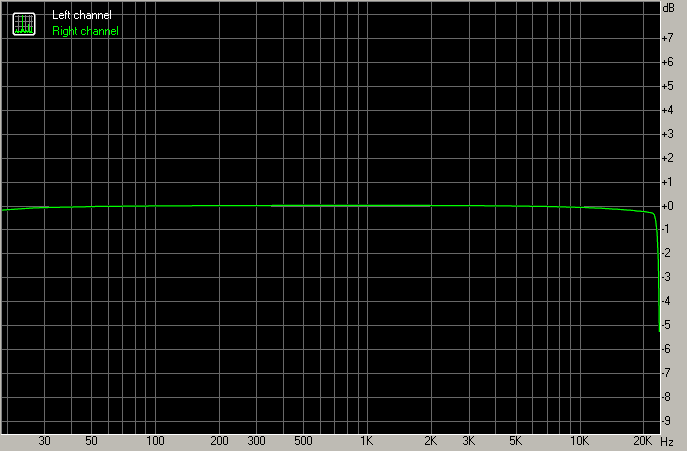
| Frequency response (from 40 Hz to 15 kHz), dB | +0.02, -0.16 |
Very good |
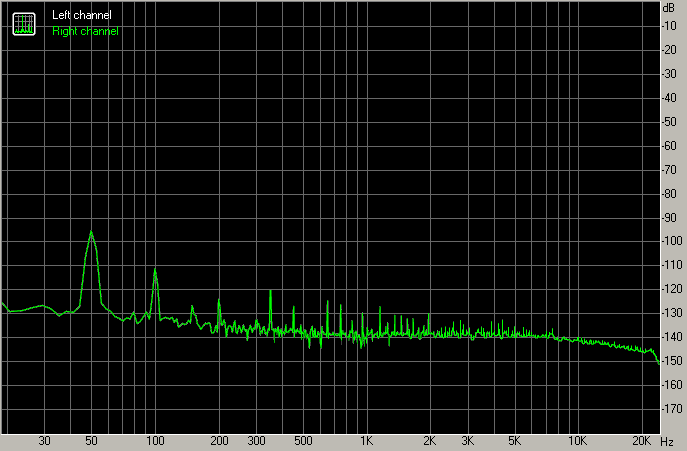
| Noise level, dB (A) | -107.1 |
Excellent |
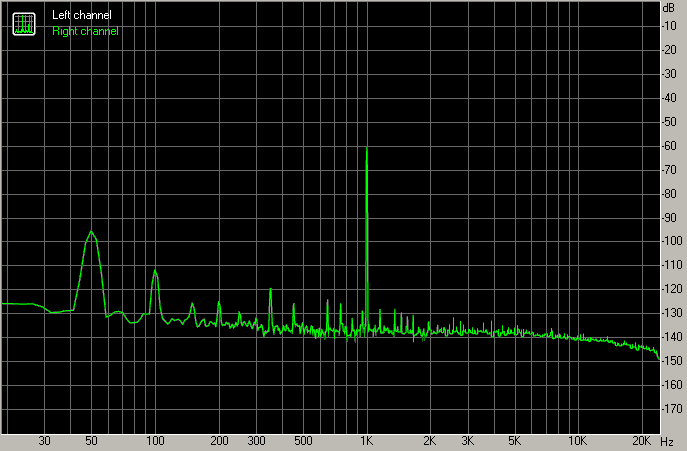
| Dynamic range, dB (A) | 107.1 |
Excellent |
| THD, % | 0.043 |
Good |
| THD + Noise, dB (A) | -65.2 |
Average |
| IMD + Noise, % | 0.040 |
Good |
| IMD at 10 kHz, % | 0.052 |
Good |
| General performance | Good |
Frequency response
Left |
Right |
|
| From 20 Hz to 20 kHz, dB | -0.24, +0.02 |
-0.24, +0.02 |
| From 40 Hz to 15 kHz, dB | -0.16, +0.02 |
-0.16, +0.02 |
Noise level
Left |
Right |
|
| RMS power, dB | -97.6 |
-97.6 |
| RMS power (A-weighted), dB | -107.1 |
-107.1 |
| Peak level, dB FS | -77.6 |
-77.6 |
| DC offset, % | -0.0 |
-0.0 |
Dynamic range
Left |
Right |
|
| Dynamic range, dB | +97.7 |
+97.7 |
| Dynamic range (A-weighted), dB | +107.1 |
+107.1 |
| DC offset, % | +0.00 |
-0.00 |
THD + Noise (at -3 dB FS)
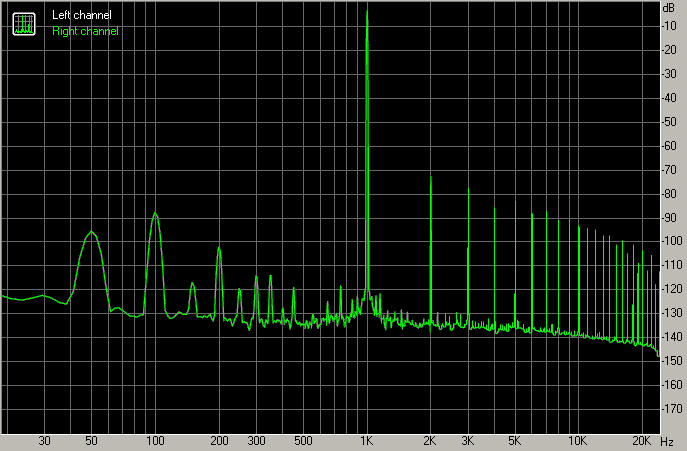
Left |
Right |
|
| THD, % | 0.04299 |
0.04299 |
| THD + Noise, % | 0.04349 |
0.04349 |
| THD + Noise (A-weighted), % | 0.05520 |
0.05520 |
Intermodulation distortion
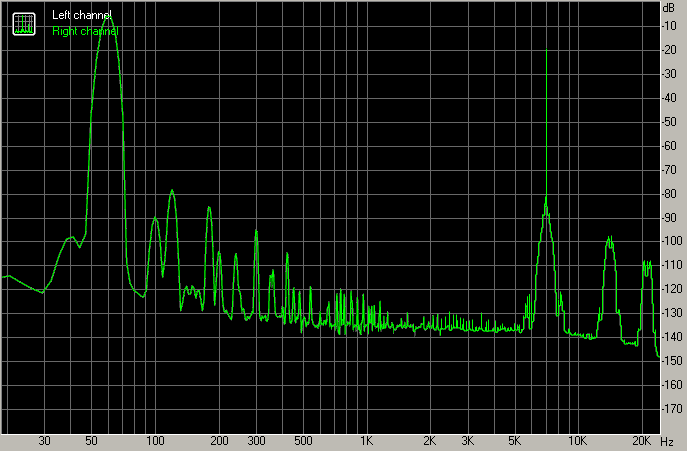
Left |
Right |
|
| IMD + Noise, % | 0.04030 |
0.04030 |
| IMD + Noise (A-weighted), % | 0.03147 |
0.03147 |
IMD (swept tones)
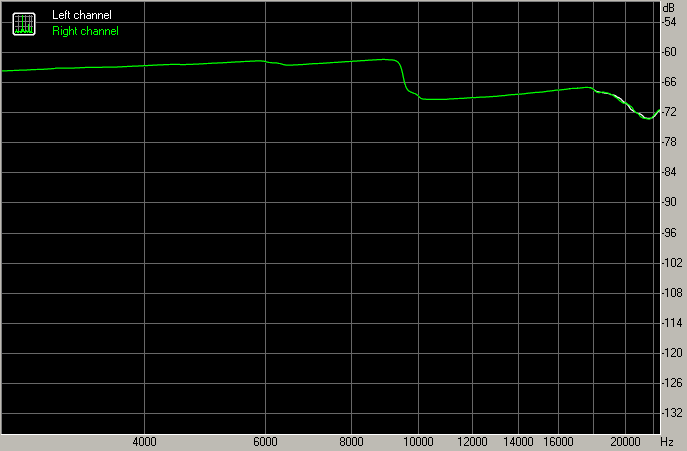
Left |
Right |
|
| IMD + Noise at 5000 Hz, | 0.07820 |
0.07820 |
| IMD + Noise at 10000 Hz, | 0.03692 |
0.03692 |
| IMD + Noise at 15000 Hz, | 0.04020 |
0.04020 |
Maximum power
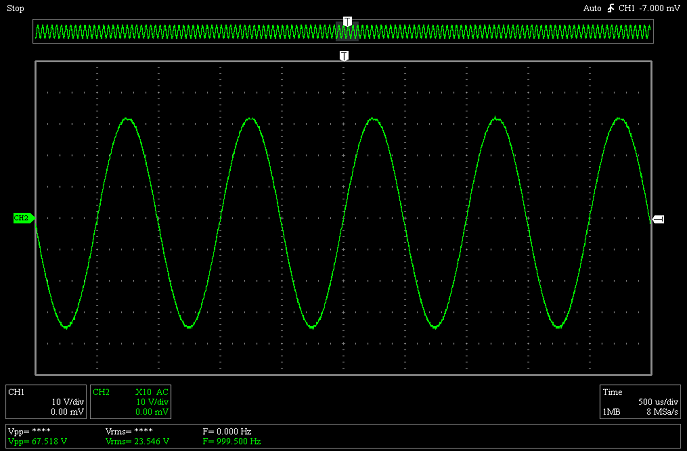
Calculation formula |
Meaning |
|
| Maximum power, W | (Vrms x Vrms) / 4 Ohm |
138 |
Conclusions
| A lot of time has passed since the advent and development of amplifiers based on powerful bipolar transistors.
During this time, the technology for manufacturing high-power field-effect transistors has also advanced a lot in
our lives, there are entire areas of consumer and industrial electronics that are simply not possible without
field-effect transistors. With the growth in the level and quality of powerful field (power) transistors, more and
more radio amateurs tried to use them in the output stages of their developments. As a result, these attempts were
successful, and the use of power field-effect transistors in amplifiers is found not only in home-made developments,
but also in industrial devices of a fairly high level.
Summary: The amplifier is built as a cheaper version of the famous and much loved LANZAR amplifier. Moreover, despite certain disadvantages of field-effect transistors, they also have a number of advantages over field-effect transistors: 1. PT can withstand noticeably large impulse loads, or rather overloads. 2. The absence of input currents, in some cases, makes it possible to significantly simplify the swinging cascades. 3. The parameters are less dependent on temperature, besides they have a large linear section of the transfer characteristic. In addition, it should be noted that the amplifier is built on quasi-complementary IRFP250N transistors, since N-channel devices, due to production features, are better transistors compared to their P-channel counterparts, and this trend is observed even in complementary pairs. You can buy the module from our store kit-amp.com. The module is recommended for building a high-quality and powerful power amplifier, and as a more affordable alternative to the LANZAR amplifier based on bipolar output transistors. |
Related Products

Amplifier LANZAR, 100W
The Lanzar amplifier is built according to the classical symmetrical scheme, the preliminary stages of which operate in class A, and the output stage in class AB.The circuit of this amplifier has been..
1820.00грн.

Amplifier MOSFET, 100W
After improving the quality of power MOSFET transistors and reducing their price, a huge part of radio amateurs began to think about using these transistors in the output stages of amplifiers. And if,..
1470.00грн.

Amplifier MOSFET, 200W
After improving the quality of power MOSFET transistors and reducing their price, a huge part of radio amateurs began to think about using these transistors in the output stages of amplifiers. And if,..
2260.00грн.
Related Articles

Amplifier LANZAR 100W, measurements
Testing device Amplifier LANZAR 100W Sampling mode 24-bit, 48 kHz Interface E-MU1616m Testing chain E-MU1616m>Amplifier LANZAR 100W>E-MU1616m Constant..

Measurement technique
Any more or less complex electronic device requires a functional check and adjustmentThe audio power amplifier is no exception and measurements of the characteristics of this device are not only a dev..

Amplifier MOSFET 200W, measurements
Testing device Amplifier MOSFET 200W Sampling mode 24-bit, 48 kHz Interface E-MU1616m Testing chain E-MU1616m>Amplifier MOSFET 200W>E-MU1616m Constant..